Nature-Based Carbon Projects: A Buyer's Guide to Afforestation, REDD+, and Mangroves
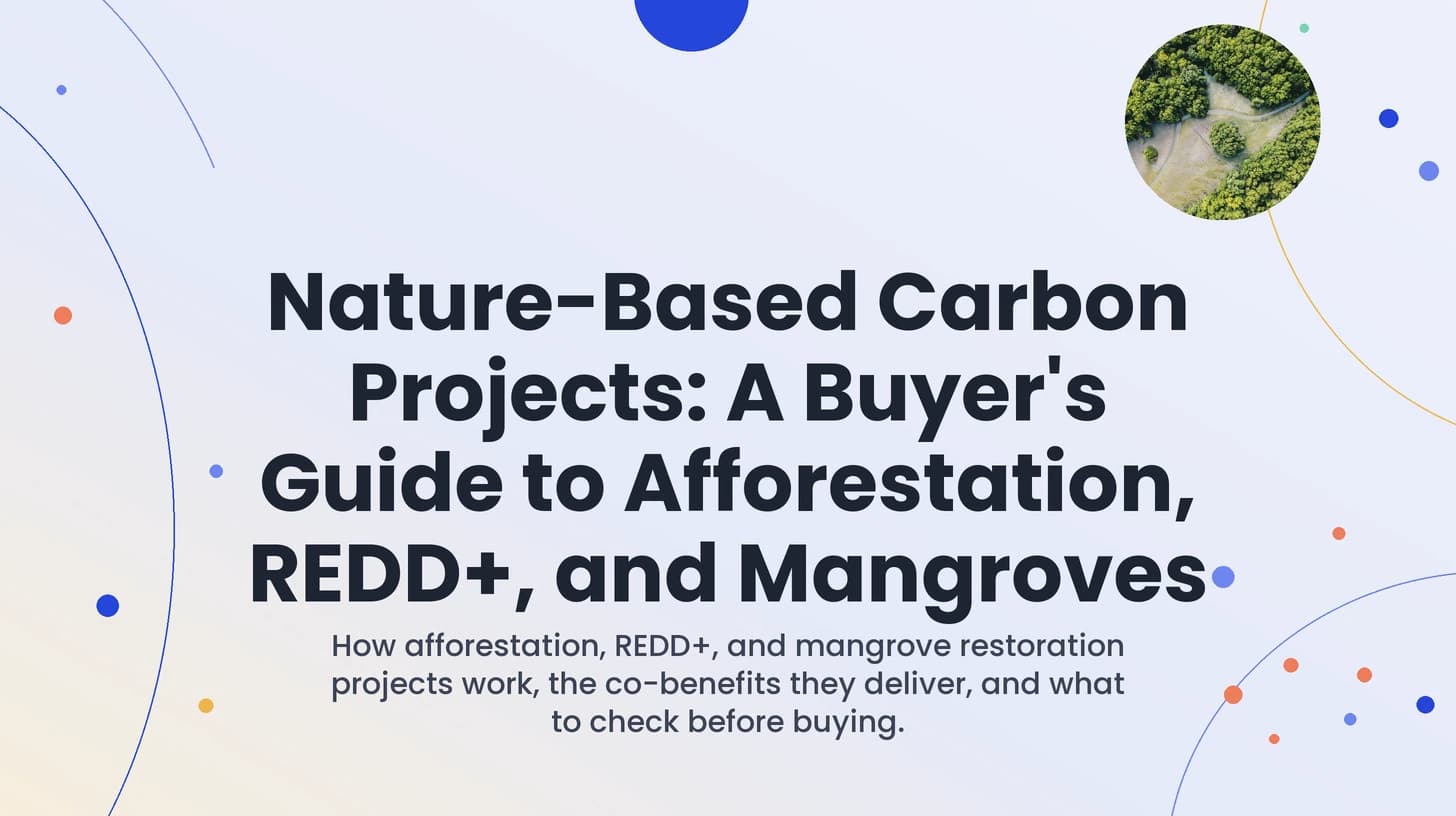
Our forests are more than just carbon credits. They are living systems that store carbon, shelter species, filter water, and provide countless other ecosystem services. Carbon credits, in the nature-based context, are simply financial tools to drive capital toward these biodiverse ecosystems to protect and restore them.
Given the inherent complexity of these natural systems, there is both huge potential and quite a lot of difficulty in carrying out effective carbon projects within them. As such, they are one of the most scrutinized corners of the voluntary carbon market, and also one where a tonne of CO₂e can bring some of the highest leverage for positive co-benefits beyond its climate impact.
In the following, we'll explore three major nature-based project types, the mechanisms behind them, the standards that certify them, and what they deliver beyond carbon. In doing so, we will provide you with a due diligence framework for evaluating nature-based projects you are considering. If you are new to the market, our primer on what carbon credits are is a good place to start.
Key Takeaways
- Nature-based carbon projects involve ecosystem activities (e.g. forests, wetlands, and mangrove habitats) to avoid emissions or remove CO₂ from the atmosphere. The three most common types are afforestation and reforestation (ARR), REDD+ (avoided deforestation), and mangrove and coastal restoration (blue carbon).
- ARR and mangrove restoration focus on carbon removal, while REDD+ focuses on avoiding emissions from continued deforestation. Both are necessary levers in the fight against climate change.
- Mangroves store more carbon per hectare than almost any ecosystem on Earth: roughly 1,494 tonnes of CO₂e per hectare including soil, against about 951 for tidal marshes and 607 for seagrass (The Blue Carbon Initiative).
- Co-benefits are a key value-add of these carbon projects. Credits with demonstrable co-benefits, including positive social and economic outcomes for local communities, have held demand better than those without (Ecosystem Marketplace, SOVCM 2025).
- Carbonmark's Marketplace publishes the registry, methodology, vintage, country, SDG mapping, and full project description for every listing, so the checks in this article can be run before you commit.
What Does "Nature-Based" Actually Mean?
A nature-based solution (NbS) uses the natural carbon cycle to deliver a climate outcome. Plants pull CO₂ out of the air through photosynthesis and store the carbon in wood, roots, and soil. A carbon project turns that biological process into a financed, measured, and verified activity.
Within that category, projects split along the same line that runs through the whole carbon market:
- Avoidance projects prevent emissions that would otherwise occur. For example, protecting a forest slated for clearing keeps carbon locked in trees that would have been released otherwise.
- Removal projects take CO₂ that is already in the atmosphere and store it in new biomass and soil through planting and initiating restorative practices across a natural landscape.
REDD+ (Reducing Emissions from Deforestation and forest Degradation) is avoidance. Afforestation, reforestation, and mangrove restoration are removals. Both matter in different ways: avoidance slows the greenhouse gas problem, removal begins to reverse it. Frameworks such as the Science Based Targets initiative (SBTi) and the Oxford Principles push buyers toward a gradual shift from avoidance to durable removals over the next 25-30 years, while recognizing that a diversified portfolio does the most good today. Importantly, both modes of action are necessary to most effectively deal with climate change: we need to radically slow down the release of emissions from activities degrading our natural ecosystems, while concurrently scaling up efforts to remove carbon from the atmosphere that's been released by various industrial activities.
The Three Major Project Types
1. Afforestation, Reforestation, and Revegetation (ARR)
What it does: establishes or restores vegetative cover on land that is currently non-forest, or enhances carbon stocks in existing forest. Planting native species on degraded pasture, restoring a cleared watershed, and integrating trees into farmland (agroforestry) all sit here.
The mechanism: growing trees accumulate carbon in trunks, branches, roots, and the soil beneath them. Carbon credit issuance from these projects reflects measured biomass growth over time, which is why ARR projects credit slowly and over long periods, often 20 to 100 years.
A live example. The Urunday Afforestation Project in Corrientes, Argentina, establishes plantations across 3,143 hectares for high-value timber and carbon sequestration. Running for 31 years from 2016, it aims to remove over 1 million tCO₂ while supporting local employment.
2. REDD+ (Reducing Emissions from Deforestation and Forest Degradation)
What it does: pays to keep a standing forest standing, in a place where it would otherwise be cleared or degraded. The "+" covers conservation, sustainable forest management, and enhancement of forest carbon stocks.
The mechanism: REDD+ credits the difference between what happened and what would have happened. That counterfactual, the baseline, is the entire ballgame. Set it too pessimistically and the project over-credits. This is precisely where legacy REDD+ methodologies drew criticism, and it is what the new generation was built to fix — see our coverage of the ICVCM's approval of new forestry methodologies.
A live example. The Keo Seima Wildlife Sanctuary REDD+ Project in eastern Cambodia protects roughly 292,690 hectares of forest in a collaboration between the Wildlife Conservation Society and the Royal Government of Cambodia. It safeguards habitat for the world's largest population of black-shanked douc and yellow-cheeked crested gibbon, alongside 84 globally threatened species, in a landscape central to the life and culture of the Indigenous Bunong people. WCS projected the project would avoid more than 14 million tCO₂e over its first ten-year period (2010 to 2019) (WCS). Its Cash for Communities mechanism channels a share of credit revenue directly to local villages.
3. Mangrove Restoration and Blue Carbon
What it does: restores or protects coastal ecosystems, principally mangroves, tidal marshes, and seagrass meadows. For a deeper look at this category, see the role of blue carbon projects in climate change mitigation.
The mechanism: this is where the carbon density becomes remarkable. Mangroves store the bulk of their carbon not in the canopy but in waterlogged, oxygen-poor soil, where decomposition slows to a crawl and carbon accumulates for millennia. Counting soil and vegetation together, mangroves hold about 1,494 tonnes of CO₂e per hectare, compared with roughly 951 for tidal marshes and 607 for seagrass. Their annual sequestration rate, 6 to 8 tonnes of CO₂e per hectare, runs two to four times higher than mature tropical forest (The Blue Carbon Initiative).
They are also disappearing. Mangroves have been lost at roughly 2% per year, and in May 2024 the IUCN's first global Red List assessment of the ecosystem found that more than half of the world's mangrove ecosystems are at risk of collapse by 2050 (IUCN).
A live example. A project in Myanmar's Ayeyarwady Division is restoring 2,265 hectares of degraded mangrove land across the Magyi, Thabawkan, and Thaegone village tracts, planting native Rhizophora mucronata and Bruguiera gymnorrhiza under VCS from 2015 to 2035. Myanmar holds some of the world's richest mangrove ecosystems and one of its highest deforestation rates, with only 5% of its mangroves legally protected. The project includes the country's first mangrove gene bank.
How the Three Types Compare Side by Side
| Afforestation / Reforestation (ARR) | REDD+ | Mangrove / Blue Carbon | |
|---|---|---|---|
| Climate outcome | Removal | Avoidance | Removal (and avoidance where conservation is included) |
| Core mechanism | New growth accumulates carbon | Standing forest is protected from clearing | Coastal vegetation plus carbon-rich waterlogged soil |
| Key methodologies | VM0047, AR-ACM0003 | VM0048, ART TREES v2.0, JNR v4.1 (CCP-eligible); VM0007, VM0015 (legacy) | VM0033, AR-AM0014 |
| Carbon density | Moderate, builds over decades | High per hectare protected | Highest per hectare of any of the three |
| Main integrity question | Additionality and survival of plantings | Baseline construction | Hydrological restoration and site suitability |
| Typical co-benefits | Jobs, soil health, watershed, timber income | Biodiversity, Indigenous and community rights, habitat | Storm protection, fisheries, coastal livelihoods |
Co-Benefits: Where a Tonne Does More Than a Tonne
While every tonne of CO₂e is chemically identical, the co-benefits and ancillary benefits that surround that tonne are not.
Nature-based projects are one of the densest sources of co-benefits in the carbon market, because protecting or restoring an ecosystem inevitably does more than move carbon. The Myanmar mangrove project maps to nine of the seventeen UN Sustainable Development Goals. Keo Seima protects 84 globally threatened species and channels revenue to Indigenous communities. Silvopastoral agroforestry projects improve soil, diversify farmer income, and build drought resilience at the same time as they sequester carbon.
Co-benefits are also a market signal. Ecosystem Marketplace's State of the Voluntary Carbon Market 2025 found that as forestry and land-use trading volumes fell overall in 2024, credits from projects with robust environmental or social benefits, including biodiversity, community support, and sustainable land use, remained in demand. Buyers are increasingly paying for the whole story, not just the tonne. As capital shifts to the projects with more holistic co-benefits, climate financing can make its way to the projects that are having the largest outsized benefit for both land and people.
What Should Buyers Check Before Purchasing?
Nature-based projects reward diligence and offer opportunities for holistic impact. The four checks below will help you contribute to climate, social, and economic benefits for the land and communities around them:
1. Permanence, and who carries the reversal risk. Verra requires AFOLU projects to contribute a share of credits, set by a non-permanence risk assessment, to a pooled buffer account. Those credits cannot be traded. If a project suffers a reversal through fire, pests, or illegal logging, an equivalent quantity is cancelled from the buffer. Check that the project has a buffer contribution and a monitoring plan that extends well beyond the crediting period. All projects listed on Carbonmark include buffer pools via their utilized methodologies and standards.
2. Verified co-benefits, not asserted ones. An SDG icon on a listing is a mapping. A CCB or SD VISta certification is an audit. Both are useful. Know which one you are looking at.
3. Leakage. If deforestation simply relocates outside the project boundary, the atmosphere gains nothing. Credible methodologies require leakage to be quantified and deducted. The projects listed on Carbonmark are issued under methodologies that account for carbon leakage metrics.
4. Diversify across types and geographies. No single project type covers every risk. A portfolio blending removals and avoidance, across regions and ecosystems, is more resilient than a concentrated position in any one of them. Rather than offsetting e.g. 1000 tonnes all from one project, consider supporting 2-3 different projects to build your own impactful carbon project portfolio.
How Carbonmark Helps You Run These Checks
Most of the checks above fail for a rather mundane reason: the information is simply scattered and fragmented across registry PDFs, broker decks, and project documents that are hard to compare side by side.
Carbonmark addresses this challenge by publishing key project information in one place. Every project listing on the Carbonmark Marketplace carries:
- Registry and project ID (VCS, ICR, Puro.Earth, Cercarbono, T-VER, Carbonmark Direct), so you can trace the credit back to its source record.
- Methodology and category, named explicitly, so VM0048 and VM0015 are never confused with each other.
- Vintage and available volume per listing, priced separately, so the vintage premium is visible rather than buried.
- Country and region, for geographic diversification and jurisdictional context.
- Mapped UN SDGs and a full project description covering the developer, area, species, and community programs.
Carbonmark currently supports 150+ carbon projects and has retired over 1,000,000 tCO₂e on behalf of clients. You can filter by project type, geography, and co-benefits to build a portfolio that matches your strategy, buy fractionally from as little as 1 kg (0.001 tonnes), and receive an instant retirement certificate settled on a public blockchain, with a transaction link anyone can independently verify.
For larger or bespoke portfolios, the Carbonmark Solutions Team can help structure a mix across ARR, REDD+, and blue carbon. For teams that want to embed offsetting into a product or checkout flow, the Carbonmark API exposes the same catalogue programmatically.
The Case for Getting This Right
Nature-based carbon projects sit at an unusual intersection. They are one of the most criticized parts of the voluntary carbon market and, simultaneously, one of the few mechanisms channelling private capital into tropical forest protection and coastal restoration at any real scale.
The criticism has been productive. Co-benefit certification has matured. Buyers have better information than they did three years ago, and the market has begun to price integrity rather than volume.
Leveraging ecosystem restoration is one of our most powerful tools to fight climate change. We hope what we've built, and the tooling we've developed for both individuals and businesses, will help you join us in that fight.
Frequently Asked Questions
What are nature-based carbon projects?
Nature-based carbon projects use ecosystems such as forests, wetlands, and soils to avoid emissions or remove CO₂ from the atmosphere. The three most common types are afforestation and reforestation (ARR), REDD+ (protecting forests from deforestation), and mangrove and coastal restoration, also known as blue carbon.
What is the difference between REDD+ and afforestation credits?
REDD+ credits are avoidance credits: they pay to keep an existing forest standing that would otherwise be cleared, and the climate benefit is the emissions that did not happen. Afforestation and reforestation credits are removal credits: new trees pull CO₂ out of the atmosphere and store it in biomass and soil. Both are legitimate, and many buyers hold a mix.
Which standards certify nature-based carbon credits?
The main ones are Verra (VCS), Gold Standard, Plan Vivo, ART (TREES), Cercarbono, and the International Carbon Registry, alongside national programs such as Thailand's T-VER. Co-benefits can be separately certified under the CCB Standards or SD VISta, and the ICVCM's Core Carbon Principles label provides a cross-standard quality benchmark.
Why are mangrove carbon credits more expensive?
Mangroves store roughly 1,494 tonnes of CO₂e per hectare including soil carbon, more than almost any other ecosystem. Their restoration projects are technically demanding and often small. They also deliver unusually broad co-benefits, including storm protection, fisheries, and coastal livelihoods, which supports a higher price per tonne.
Sources
- ICVCM, Integrity Council approves three REDD+ methodologies (15 November 2024): icvcm.org
- Verra, VM0047 Afforestation, Reforestation and Revegetation v1.1: verra.org
- Verra, Verra Revises Blue Carbon Methodology (VM0033): verra.org
- Verra, Climate, Community & Biodiversity (CCB) Standards: verra.org
- Verra, Verified Carbon Standard Version 5: verra.org
- The Blue Carbon Initiative, About Blue Carbon: thebluecarboninitiative.org
- IUCN, More than half of all mangrove ecosystems at risk of collapse by 2050 (May 2024): iucn.org
- Ecosystem Marketplace, State of the Voluntary Carbon Market 2025: ecosystemmarketplace.com
- Wildlife Conservation Society, Cambodia's Keo Seima Wildlife Sanctuary Sells First Carbon Credits: newsroom.wcs.org
- Gold Standard, Nature Based Solutions: goldstandard.org
- Carbonmark projects: Urunday Afforestation Project (CMARK-3), Keo Seima Wildlife Sanctuary REDD+ (VCS-1650), Reforestation and Restoration of Degraded Mangrove Lands, Myanmar (VCS-1764): app.carbonmark.com